
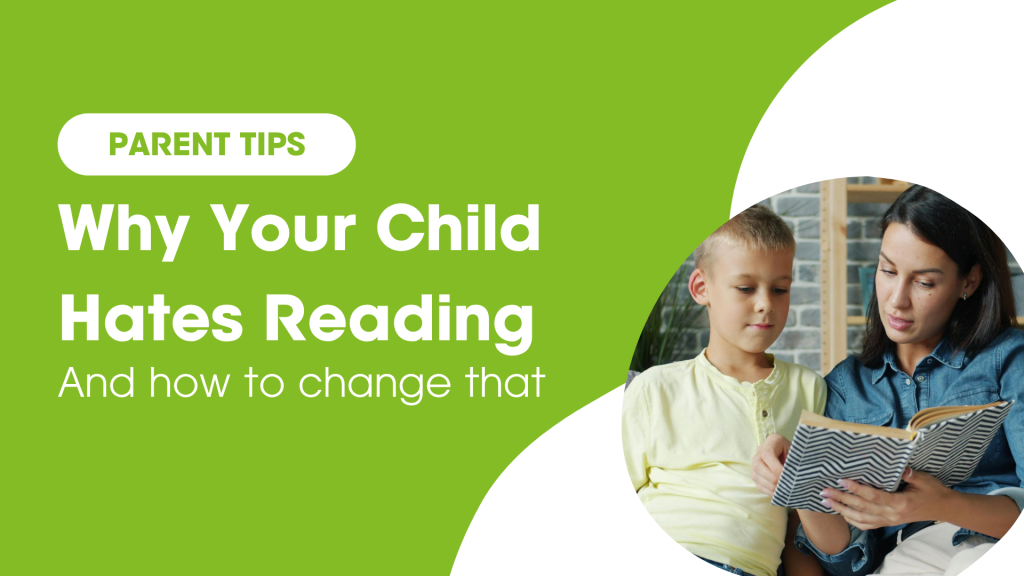
If your child hates reading and getting them to pick up a book feels like pulling teeth, you are not imagining it. You are definitely not alone. Plenty of children resist reading, and it is rarely because they are lazy or just not a reader. There is almost always a specific reason, and once you find it, you can actually do something about it.
Here are the most common culprits, and what to try instead.
The Books Are at the Wrong Level
This is the most overlooked cause of reading resistance. If the books being sent home from school are too hard, your child will associate reading with frustration. If they are too easy, reading feels boring and pointless.
The sweet spot is a book your child can read comfortably but still finds engaging. As a rough guide: if they are stumbling over more than one in every ten words, the book is probably too difficult right now. Talking to your child’s teacher about adjusting the reading level is a perfectly reasonable thing to do.
It is also worth remembering that reading level and intelligence are not the same thing. A child reading below their year level simply needs the right starting point, not a label.
They Have Not Found Their Books Yet
Adults who love reading almost always have a moment they can point to: the series, the author, the genre that made reading feel worthwhile. Many children are still waiting for that moment.
Rather than directing them toward what you think they should read, follow their interests. A child obsessed with football might devour a sports biography. A child who loves Minecraft might happily read a book about game design or coding. The subject matter matters far less than the experience of wanting to turn the page.
Reading Has Become a Chore
If reading time is always tied to school, always assessed, always corrected, always followed by comprehension questions, some children start to experience it as work rather than pleasure. The pressure to read correctly can strip away the enjoyment entirely.
Try keeping some reading time completely low-stakes. No questions afterward. No performance required. Just reading for its own sake.
There May Be an Underlying Difficulty
If your child avoids reading consistently, gets fatigued quickly, loses their place on the page, or seems to work much harder than their peers for much less result, it is worth having a conversation with their teacher or a reading specialist. Difficulties like dyslexia are far more common than many parents realise. Early, targeted support makes an enormous difference.
Avoidance is often protective behaviour. A child who hates reading may actually be a child who has found that avoiding it means avoiding feeling inadequate. Naming that gently, without pressure, can open up an important conversation.
Practical Things to Try
- Read together, even with older children. Taking turns reading aloud takes the pressure off and keeps things social.
- Let them read anything: graphic novels, joke books, magazines, recipes, game manuals. All of it counts.
- Be a reader yourself. Children who see adults reading for pleasure are significantly more likely to become readers. Even reading a newspaper or magazine in the same room as your child sends a quiet but powerful message about what reading is for.”
- Visit the library regularly and let them choose freely, without steering.
- Never make reading a punishment or use it as something to do when they are in trouble.
Eye Level’s English programme builds reading skills systematically, from phonics and decoding to comprehension and vocabulary, always at the child’s own level. Find a centre near you today and discover how Eye Level can build a reading programme tailored to exactly where your child is right now and take them from there, one step at a time.
